Learn why global experts and Indian doctors support this landmark change, what the latest research says, and how it may improve diagnosis, treatment, and awareness for millions of women.
For years, millions of women were told they had “cysts in the ovaries” when diagnosed with Polycystic Ovary Syndrome (PCOS). Yet many of them never actually had ovarian cysts. Others had symptoms far beyond the ovaries, including insulin resistance, weight gain, acne, infertility, anxiety, cardiovascular risk, and metabolic dysfunction.
Now, after more than a decade of international research and consultation, the medical community has officially introduced a new name: Polyendocrine Metabolic Ovarian Syndrome (PMOS). The change was announced in 2026 through a landmark global consensus published in The Lancet and supported by more than 50 international academic, clinical, and patient organizations.
This is not just a cosmetic name change. Experts say it reflects a major shift in how the condition is understood, diagnosed, and treated.
The older name, Polycystic Ovary Syndrome, created confusion from the beginning. The term suggested three things:
The condition is mainly about ovaries
Ovarian cysts are necessary for diagnosis
It is primarily a gynecological disorder
However, modern evidence has shown that none of these assumptions are entirely accurate.
Many women diagnosed with PCOS do not have ovarian cysts on ultrasound. What are commonly seen are immature follicles, not true cysts. At the same time, many women with polycystic-appearing ovaries may not have the syndrome at all.
Indian doctors and endocrinologists have increasingly argued that the old terminology caused delayed diagnosis and fragmented care. Patients with symptoms like insulin resistance, obesity, hair thinning, fatigue, acne, mood disorders, or irregular ovulation were often treated symptom-by-symptom instead of receiving holistic care.
Experts now believe the name itself unintentionally narrowed the clinical approach.
The new name — Polyendocrine Metabolic Ovarian Syndrome — was chosen carefully to reflect the multisystem nature of the disorder.
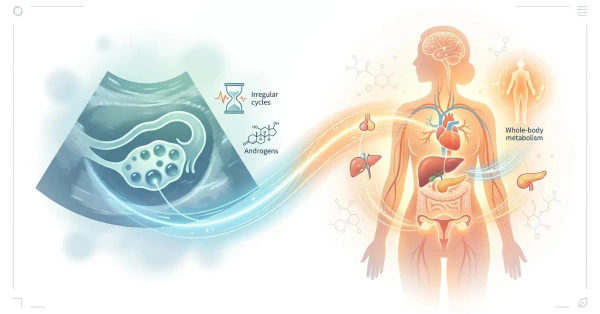
This highlights that multiple hormonal systems are involved, not just the ovaries. Hormones related to insulin, androgens, adrenal function, and reproductive regulation are all interconnected.
This is perhaps the most important addition. Research now strongly links the condition to:
Insulin resistance
Prediabetes and type 2 diabetes
Weight dysregulation
Cardiovascular risk
Fatty liver disease
Chronic inflammation
By including “metabolic” in the name, doctors hope women and clinicians will take these long-term health risks more seriously.
The ovaries are still involved, especially in ovulation and fertility issues, but they are no longer portrayed as the sole focus of the disease.
The renaming process was not sudden. It followed a 14-year international collaboration involving:
Researchers
Endocrinologists
Gynecologists
Mental health experts
Patient advocacy groups
Women living with the condition
According to the Endocrine Society, over 22,000 stakeholders contributed to surveys, workshops, and consensus-building exercises before the final terminology was adopted.
The final consensus was published in The Lancet and presented at the European Congress of Endocrinology in 2026.
Professor Helena Teede, one of the leading experts behind the initiative, stated that the older name reduced a complex endocrine condition into a misunderstood “ovarian cyst problem,” contributing to underdiagnosis and inadequate treatment.
India has one of the highest burdens of PCOS globally, particularly among urban adolescents and young women. Some Indian studies estimate that nearly 1 in 5 young women may be affected.
Indian clinicians have increasingly observed that patients often:
Ignore symptoms if they do not have “cysts”
Believe it is only a fertility issue
Seek treatment only for cosmetic concerns like acne or facial hair
Remain unaware of future diabetes or cardiovascular risks
According to experts quoted in AIIMS discussions and Indian medical coverage, the term PMOS may improve early screening because it better communicates the condition’s metabolic and endocrine nature.
Indian doctors also believe the new terminology may reduce stigma. Many patients associated the word “cyst” with severe disease, tumors, or infertility, causing unnecessary fear and shame.
By reframing the condition as a broader hormonal-metabolic syndrome, the conversation becomes more scientifically accurate and less emotionally distressing.
The renaming movement was deeply influenced by the 2023 International Evidence-Based Guideline for PCOS assessment and management, led largely by Australian researchers and global collaborators.
The guideline emphasized that the condition affects:
Reproductive health
Metabolic health
Cardiovascular risk
Mental wellbeing
Dermatological health
It also highlighted the need for multidisciplinary care involving:
Gynecologists
Endocrinologists
Dietitians
Mental health professionals
Fertility specialists
This evidence-based approach reinforced the argument that the old name no longer reflected scientific understanding.
One of the biggest goals of the PMOS terminology is earlier and more accurate diagnosis.
Under the older framework, women without visible ovarian cysts were sometimes dismissed despite having:
Irregular periods
Elevated androgen levels
Insulin resistance
Hair loss
Acne
Weight issues
Experts say the PMOS framework encourages clinicians to look at the entire endocrine-metabolic picture instead of focusing mainly on ultrasound findings.
This is especially important for:
Lean PMOS patients
Adolescents
Women with regular-looking cycles but poor ovulation
Patients with metabolic dysfunction but subtle gynecological symptoms
Another major reason behind the renaming is mental health awareness.
Research increasingly shows that women with the condition face higher rates of:
Anxiety
Depression
Body image issues
Eating disorders
Social stigma
Many patients reported feeling unheard because the term PCOS minimized their broader symptoms. Online communities and patient groups frequently discussed how the “ovary-focused” terminology failed to explain fatigue, mood changes, and metabolic struggles.
The PMOS terminology validates the fact that this is a whole-body disorder rather than simply a reproductive issue.
At present, the diagnostic criteria remain largely based on the Rotterdam criteria:
Irregular ovulation
Elevated androgens
Polycystic ovarian morphology
Two out of three are still typically required for diagnosis.
However, experts believe the broader PMOS framework may eventually encourage more comprehensive metabolic screening, including:
Insulin resistance testing
Lipid profiles
Mental health assessment
Cardiovascular risk evaluation
The move from PCOS to PMOS represents more than updated terminology. It reflects a deeper evolution in women’s healthcare.
For decades, many women struggled with delayed diagnosis because medicine focused too narrowly on the ovaries. The newer understanding recognizes that the condition involves hormones, metabolism, inflammation, mental health, and long-term systemic risk.
By adopting the term PMOS, experts hope to:
Improve public awareness
Encourage earlier diagnosis
Reduce stigma
Promote multidisciplinary care
Improve long-term health outcomes
For millions of women worldwide, including a rapidly growing population in India, the name change may finally align medical language with medical reality.
About PeriodSakhi
PeriodSakhi is your trusted companion for understanding your menstrual health. With easy-to-use tools, it helps you track your periods, ovulation, fertility, moods, and symptoms, while providing insights into your overall reproductive and hormonal health. PeriodSakhi also serves as a supportive online community where women can share experiences, find reliable information, and access expert-backed guidance on menstrual health, PCOS, pregnancy, lifestyle, and more.
Disclaimer
The views, thoughts, and opinions expressed in this article/blog are solely those of the author and do not necessarily reflect the views of PeriodSakhi. Any omissions, errors, or inaccuracies are the responsibility of the author. PeriodSakhi assumes no liability or responsibility for any content presented. Always consult a qualified medical professional for specific advice related to menstrual health, fertility, pregnancy, or related conditions.
Start the conversation
No comments yet. Start the conversation by leaving the first comment!