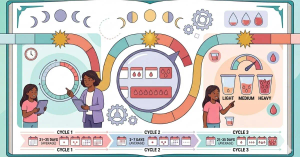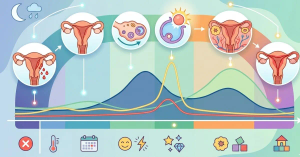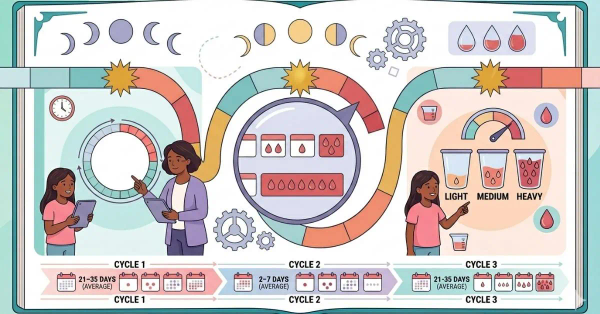
“A period is more than a monthly cycle, it is a window into your body’s internal balance.” Many women grow up hearing what periods should look like, but few are taught what is actually considered medically normal. Understanding your menstrual flow, cycle length, and duration can help you feel more in control of your health and recognize early signs of conditions like Polycystic Ovary Syndrome or Thyroid Disorders.
Every cycle tells a story. Learning to read it is one of the simplest yet most powerful ways to care for your body.
1. Normal Cycle Length
The menstrual cycle is counted from the first day of one period to the first day of the next.
Normal range:
21 to 35 days in adults
21 to 45 days in adolescents (especially in the first few years after menarche)
What matters more than the exact number is regularity.
If your cycle comes roughly at the same interval every month, that is a reassuring sign of hormonal balance.
This refers to how many days you bleed during each cycle.
Normal duration:
3 to 7 days
1–2 days → may be too short (can be normal for some but worth observing)
More than 7 days → considered prolonged bleeding
Your flow may start light, become heavier in the middle days, and taper off again. That pattern is completely normal.
Flow is often the hardest to judge, but there are practical ways to understand it.
Average blood loss:
Around 30–80 ml per cycle (you don’t need to measure this exactly)
In real-life terms:
Changing a pad/tampon every 3–4 hours is typical
Using 3–6 pads per day on heavier days is common
No need to change protection every 1–2 hours
Small clots (coin-sized or smaller) can occur
You can carry out daily activities without major restriction
Mild cramping during periods, known as Dysmenorrhea, is common.
Normal pain:
Starts just before or during the first 1–2 days
Improves with rest, heat, or mild pain relief
Not normal:
Pain so severe that you miss work, school, or daily activities
Pain that worsens over time
You should consider consulting a doctor if you notice:
Cycles shorter than 21 days or longer than 35 days consistently
Periods lasting more than 7 days
Very heavy bleeding (soaking pads every 1–2 hours)
Large clots (bigger than a coin)
Missed periods for 3 months or more (not pregnant)
Severe pain that interferes with life
These could be linked to conditions like Polycystic Ovary Syndrome, Endometriosis, or Thyroid Disorders.
Your “normal” might not look exactly like someone else’s and that is okay. The key is to know your baseline. Once you understand your own cycle pattern, you can quickly identify when something changes.
Tracking your periods (even in a simple calendar or app) can be one of the most powerful tools for early detection of health issues.
A normal period is not defined by perfection, it is defined by consistency, comfort, and balance. When your body follows a predictable pattern without excessive pain or disruption, it is usually a sign that your hormones are working in harmony.
About PeriodSakhi
PeriodSakhi is your trusted companion for understanding your menstrual health. With easy-to-use tools, it helps you track your periods, ovulation, fertility, moods, and symptoms, while providing insights into your overall reproductive and hormonal health. PeriodSakhi also serves as a supportive online community where women can share experiences, find reliable information, and access expert-backed guidance on menstrual health, PCOS, pregnancy, lifestyle, and more.
Disclaimer
The views, thoughts, and opinions expressed in this article/blog are solely those of the author and do not necessarily reflect the views of PeriodSakhi. Any omissions, errors, or inaccuracies are the responsibility of the author. PeriodSakhi assumes no liability or responsibility for any content presented. Always consult a qualified medical professional for specific advice related to menstrual health, fertility, pregnancy, or related conditions.
Start the conversation
No comments yet. Start the conversation by leaving the first comment!